Listen: Antony Laurence

Sidney Street was initially laid out in the 1820s. Charles Booth's poverty map marks Sidney Street in 1898-9 as 'Mixed: Some comfortable, others poor'. The east side of Sidney Square had a 'better class' of residents who could afford to keep a servant, unlike the poorer west side on Sidney Street.1 George Arkell's 1899 Map of Jewish East London shows that between fifty and seventy- five per cent of Sidney Street's population was Jewish. Sidney Street Synagogue (Federation of Synagogues, then Union of Orthodox Hebrew Congregations in the 1940s) was founded by 1915 with seventy members and closed about 1954.2
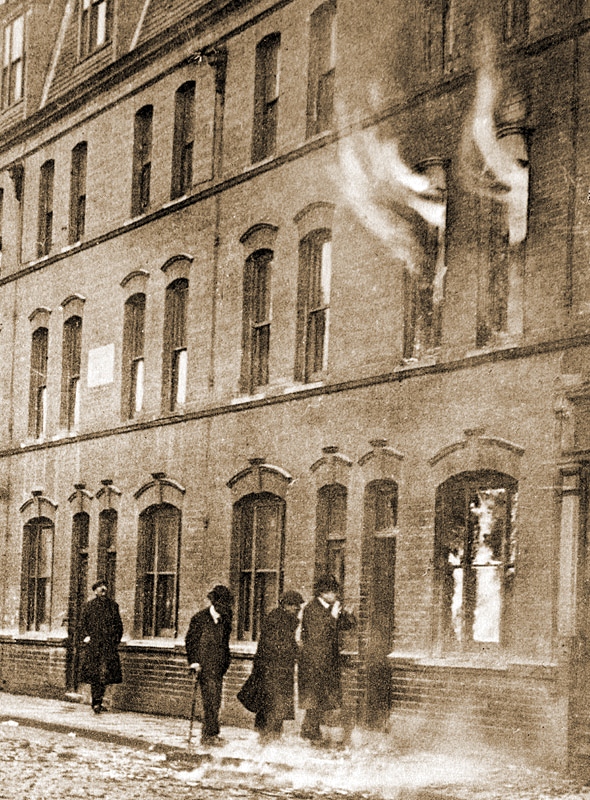
In January 1911 the notorious Siege of Sidney Street took place. Part of East End folklore, this was the aftermath of a foiled robbery in a jewellery shop in Houndsditch in December 1910, which resulted in three policemen being shot dead by Latvian immigrants and another two being injured. The siege has since inspired multiple films and works of fiction including Emanuel Litvinoff's A Death Out of Season (1973), which explores the story of Peter the Painter and describes the anarchists as 'fighting phantoms, not men of flesh and blood'.3
Other Jewish residents in Sidney Street at this time included Simcha and Esther-Reisel Sarna, who lived at no. 70 and came from Konin, a small shtetl in Poland. They were the maternal grandparents of journalist and writer Theo Richmond, whose book Konin describes Jewish life in that town before the Holocaust. Richmond describes how his family 's home in Sidney Street quickly became the central meeting place for the migrant community from Konin in London:
'In a way, it [life in Sidney Street] was a continuation of life in Konin… my father prayed in a tiny synagogue round the corner run by a Koniner. As boys we learned from a Hebrew teacher who came from Konin [Leib Lichtenstein]. There wasn't a day when we weren't visited by landslayt (fellow countrymen) from Konin. Number 70 Sidney Street became the Konin headquarters of London, where former townsfolk could pick up the latest news from home, get something to eat, a glass of lemon tea, perhaps even a loan, even when my grandfather himself was struggling to make ends meet.'
Richmond, T. Konin: A Quest. London: Jonathan Cape, 1995, p. 17.
By the outbreak of war in 1939 Sidney Street was still predominately a place of Jewish residence. The Post Office Directory for London of 1939 (page 873) records a street bustling with diverse commercial activity, but still showing remnants of the agricultural activity from a generation earlier - ranging from cow-keepers to butchers, fishmongers, hairdressers and tobacconists. As well as woollen merchants, linoleum dealers, boot manufacturers, and Samuel & Son Monumental Masons and Undertakers.
-
'Charles Booth's London'. Poverty Series Survey Notebooks (Online Archive), London School of Economics, British Library of Political and Economic Science, https://booth.lse.ac.uk/notebooks/b351, BOOTH/B/350, p. 101 (1898-9). Available at https://booth.lse.ac.uk/notebooks/b350#?c=0&m=0&s=0&cv=52&z=0%2C-9.1909%2C2494%2C1483.3819
[accessed 30.11.2019] ↩ -
Information from Shulman, D. & Jewish Genealogical Society. Jewish Communities and Records - United Kingdom (2002-2019). Entry for 'Sidney Street Synagogue' https://www.jewishgen.org/jcr-uk/london/EE_sidney/index.htm [accessed 29.11.2019]. The marriage registers in Tower Hamlets Register Office run from 1922 until 1950. ↩
-
The Cable, Issue 15, 2011 p. 8. Original footage from 1911 Siege of Sidney Street: https://www.youtube.com/watch?v=PDPHz4w3zvg ↩
Cite This Article
Sidney Street, jewisheastendmemorymap.org?feature_type=point&id=42, accessed December 2025.