Listen: Bernard Kops, Alex Moss, Emma Krais

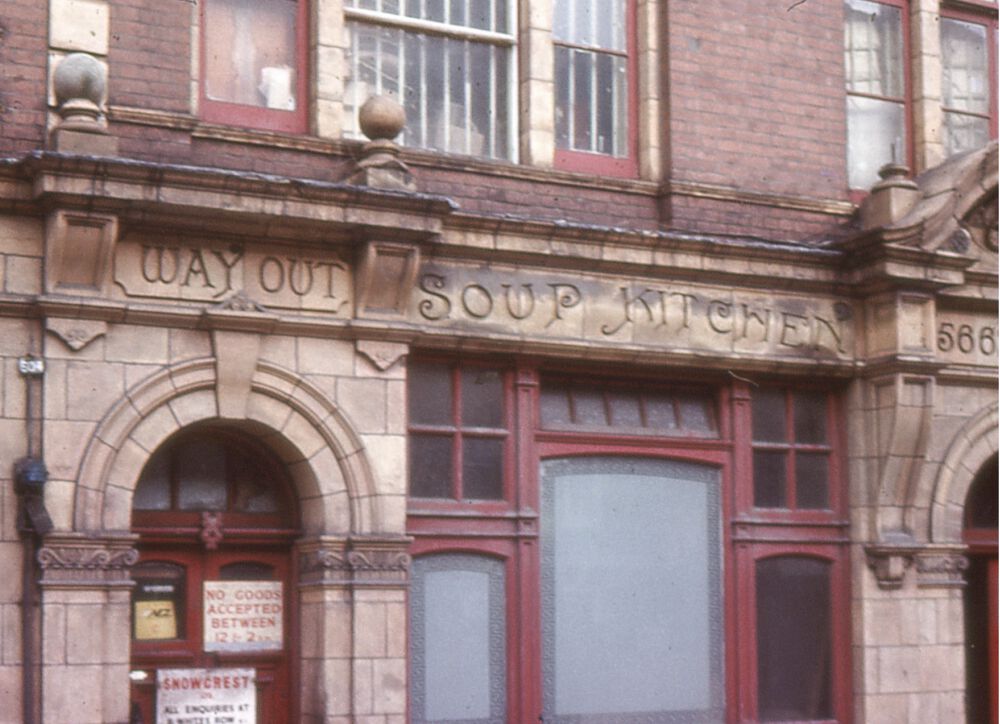
The London Hebrew Soup Kitchen or Jews' Soup Kitchen was originally founded in Leman Street in 1854, to provide soup, meat and bread twice a week to the Jewish poor living in East London. Back then, before the Welfare State, the soup kitchen provided an essential service for refugees arriving without any means. The Soup Kitchen later moved to Black Horse Yard in Aldgate, and then to No. 5 Fashion Street before a purpose-built building was erected in Butler Street (now called Brune Street) in 1902 - designed by the well-known Jewish architect Lewis Solomon. For nearly a century this building provided weekly rations of bread, meat, soup and coal to the Jewish poor in the area. It was busiest during the Great Depression when it provided meals for more than 5,000 Jewish people each week. As the audio clip demonstrates, it was still providing a necessary service both before and after the Second World War for the Jewish poor in the area.
'For it was known to all men that soup and bread were to be had for the asking thrice a week at the institution in Fashion Street, and in the Ansell household the opening of the soup-kitchen was looked forward to as the dawn of a golden age, when it would be impossible to pass one more day without bread. The vaguely remembered smell of the soup threw a poetic fragrance over the coming winter… tonight Esther fared to the kitchen, with her red pitcher, passing in her childish eagerness numerous women shuffling along on the same errand… There was quite a crowd of applicants outside the stable-like doors of the kitchen when Esther arrived, a few with well-lined stomachs, perhaps, but the majority famished and shivering. The feminine element swamped the rest, but there were about a dozen men and a few children among the group, most of the men scarcely taller than the children - strange, stunted, swarthy, hairy creatures, with muddy complexions illumined by black twinkling eyes… a few with shaggy beards or faded scarves around their throats. Here and there… was a woman of comely face and figure, but for the most part it was a collection of crones, prematurely aged, with weird, wan, old-world features, slip-shod and draggle-tailed, their heads bare, or covered with dingy shawls… Polish, Russian, German, Dutch Jewesses… at half-past five the stable doors were thrown open, and the crowd pressed through a long, narrow white-washed stone corridor into a barn-like compartment… behind the white deal counter, was gathered a group of philanthropists… in the corner stood the cooking-engine. Cooks in white caps and blouses stirred the steaming soup with long wooden paddles… Esther's mouth watered as she struggled for breathing space on the outskirts of paradise.'
Zangwill, I. Children of the Ghetto: A Study of a Peculiar People. London: Heinemann, 1892 (1922 edition), p. 4: 'The Bread of Affliction'.
By 1951 the Soup Kitchen provided assorted foods for as many as 1,500 people still living in the area before moving to kosher meals on wheels for the predominately elderly Jewish community left in East London. The Soup Kitchen closed in 1992 having served the community for over 90 years and merged with Jewish Care at Beaumont Grove in Stepney. The façade is now Grade II listed and the building has been turned into flats. Above the door the purpose of the building and the date is written in terracotta lettering. The façade is now one of the only visible tangible remnants of the former Jewish East End and a stark reminder of the desperate need and poverty of many in the community.
You can see a short video clip taken outside the Soup Kitchen in 1934 on the British Film Institute website, here: https://player.bfi.org.uk/free/film /watch-soup-kitchen-1934-online.

The Spitalfields Soup Kitchen, from Illustrated London News, 1870
Cite This Article
Soup Kitchen for the Jewish Poor, jewisheastendmemorymap.org?feature_type=polygon&id=1, accessed December 2025.