Listen: Leo Epstein, Amanda Myers, Majer Bogdanski

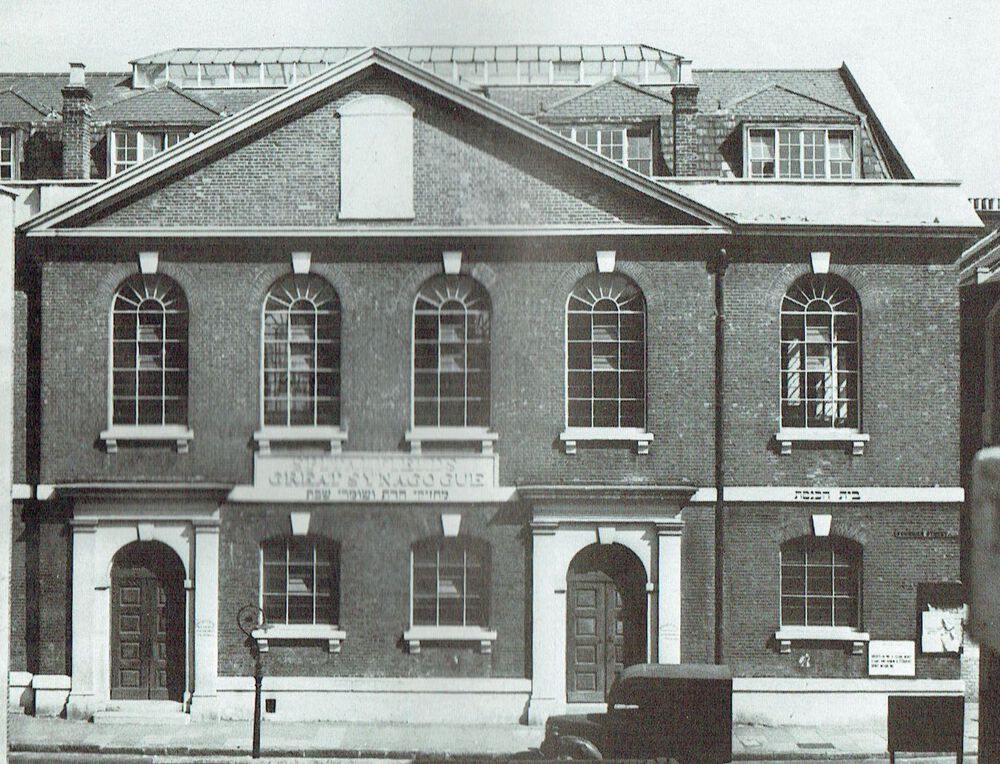
The Neuve Église on Fournier Street (formerly Church Street) is perhaps the most famous example of the type of religious continuity and change found across the East End. It was originally a church, and then for a short while a mission: the London Society for Promoting Christianity Among the Jews. The society had little impact on the growing Jewish population of the area and the building was sold in 1819 to the Methodists. In 1899 it formally became the synagogue of the Machzike Hadath at a conversion cost of some £6,000.
In 1920 the building, previously rented from the residual Huguenot community, was purchased outright by the Machzike Hadath society, who renamed it Spitalfields Great Synagogue (attached next door was The Brick Lane Talmud Torah School, see entry 21). The synagogue was orthodox, but was modelled on the Eastern European system, with its own authority of marriages and divorces and certification of kosher food ( kashrut ). Rejecting the United Synagogue's kashrut certification, which Machzike Hadath (literally, 'Keepers of the Faith') deemed as lax, the conflict between the organisations was played out internationally - but also locally - on billboards, shop windows and around the streets of East London.1
The Synagogue is only dimly lighted. Here and there a few worshippers are sitting in the pews repeating their prayers or reading a tattered volume. In one pew sits an old man writing by the aid of a tallow candle, which he has stuck on the little shelf in front of him. He is writing out one of the tiny scrolls which, encased in a capsule of tin or glass, forms the "Mezuzah", the amulet which every orthodox Jew places on his doors; or perhaps the miniature manuscript is intended to be placed inside the "Tephillin" - that is, the phylacteries which are bound round the head and the left arm for the morning prayers. Remembering that the Mezuzah and the Tephillin are direct Sinaitic ordinances, we look at the old man writing by the gleam of the candle in the gloomy synagogue with feelings of awe and reverence.
Sims, G. R. 'Off the Track in London', Strand Magazine: An Illustrated Monthly, 27(160), 1904, pp. 416-23.
While its centrality to Jewish life in the East End continued for the first half of the twentieth century, as we can see in the snippets captured by A. B. Levy after his journey of exploration of the neighbourhood following the Second World War, where he found that 'Mourners who work in the East End know that here they can find a quorum for Kaddish',2 that this was a period of a progressive dwindling of the Jewish presence in the district. The memories collected in the 1953 book about the synagogue evoke a bygone era.
'My earliest recollections of the Machzike Hadath Synagogue go back to my boyhood. What a magnificent appearance it presented during the High Festivals! What a splendid array of Talmudic scholars along the honoured Eastern Wall! The shool overcrowded with extra chairs all round the Bemah and in front of these, personal 'prayer-stands' suitably covered, with everybody keyed up to the importance of the occasion. One just felt the holiness of the place. And with what fervour were the prayers uttered! When the moment came for the Congregation to recite a prayer they could hardly wait for the Chazan to finish his part before they would burst out in one loud accord impatient to show their devotion. And when the Sepharim were carried to the Bemah, how all thronged to kiss them! And the occasional banging by the Shammas on a heavy Machzor often accompanied by a loud 'Shah' to silence the more audible women- folk in the galleries hidden from view behind lace curtains.'
Homa, B. A fortress in Anglo-Jewry: the story of the Machzike Hadath. London: Shapiro, Vallentine, 1953, p. 77.
Following the synagogue's fall into disuse, and given the influx of a new migration into the neighbourhood from the Sylhet district of Bangladesh, the building was purchased by the local Muslim community in 1974, and it is now the Jamme Masjid mosque. It holds up to 4,000 worshippers at a time and is as packed on Ramadan as it once was on Yom Kippur. High on the wall, above the Fournier Street entrance, is the Latin inscription 'Umbra Sumus', which translates as 'We are Shadows'. Opposite the mosque, at no. 88 Brick Lane, is the site of the former Russian Vapour Baths that were frequented by orthodox Jews until the building was destroyed during the Blitz. There is now a Bangladeshi Cash and Carry on that site.
Cite This Article
Machzike Hadath, Spitalfields Great Synagogue, jewisheastendmemorymap.org?feature_type=polygon&id=22, accessed December 2025.