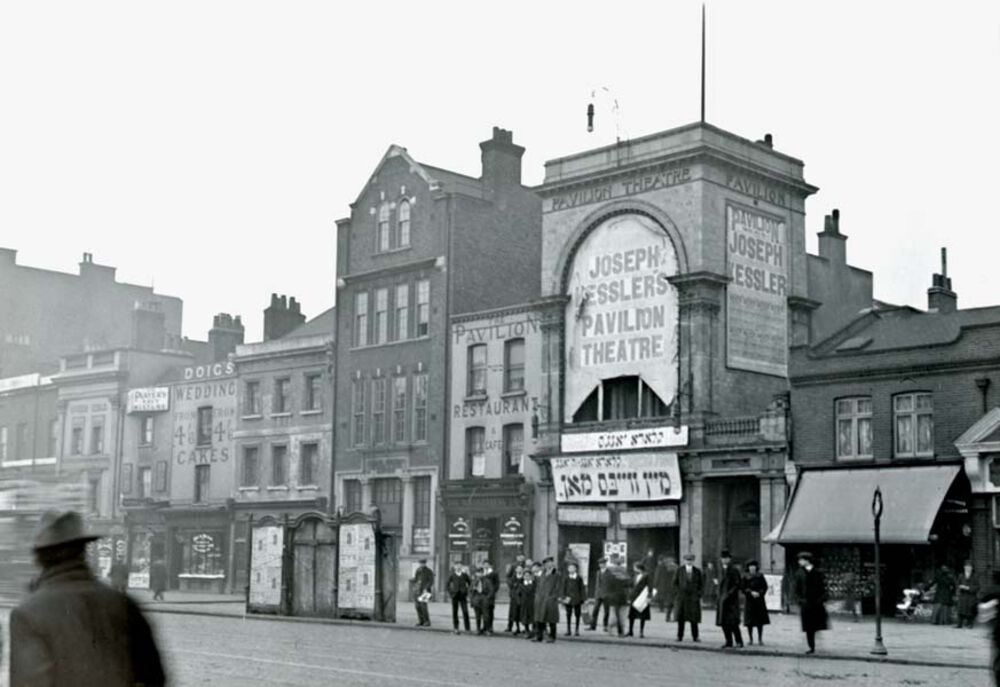
The Pavilion Theatre at 193 Whitechapel Road, in business here for little more than a century (1827 to 1934), occupies a place of importance in London's theatre history.1 Its first incarnation was a small playhouse, opened by February 1827 and within the year billed as the new Royal Pavilion Theatre. Fire destroyed the empty theatre in 1856 and a much larger structure opened in 1858 as the 'New Royal Pavilion Theatre', claiming also to be 'The Great Nautical Theatre of the Metropolis'.
From 1871 the Pavilion's proprietor had been Morris Abrahams, who had built the even larger East London Theatre across the road in 1867. Extensive alterations were made over the next decades and by 1906-8 the theatre had a capacity of 1,832 of which 516 were standing and 500 in the gallery. Now managed by Isaac Cohen, this vast home to melodrama and pantomime was 'the Drury Lane of the East'.
After 1900 the Pavilion became the principal Yiddish theatre in London. In the same year a meeting in support of the establishment of a Jewish theatre in east London drew more than 2,000 to the Pavilion - 'it was an auditorium where everybody knew everybody else, and was not ashamed to say so, in strident tones to be heard from gallery to stalls. The noise never stopped.' 'The Pavilion Theatre seemed the most wonderful place in the world… It was a rallying place for all East End Jewry.'
Management passed to Jacob Woolf Rosenthal, who in 1911 proposed embracing cinema to solve the theatre's constant financial problems. The Whitechapel Foundation, freeholder and neighbour, agreed to this, but resisted proposals for Sunday opening, the Jewish clientele notwithstanding. Rosenthal left but returned in 1922 and stayed until the end. The reopening after minor alterations in 1922-3 was marked with a large projecting illuminated sign at first-floor level advertising 'VILNA TROOP'. This announced the arrival in London of the famous Lithuanian Modernist Yiddish theatre company, which brought its production of Sholem Asch's controversial The God of Vengeance. Set in a brothel and with a sympathetic portrayal of a lesbian relationship, it was shut down by the censor.
Sid Hyams, of a family of East End Jewish cinema entrepreneurs, proposed an ambitious but unrealised redevelopment for a theatre to take more than 5,000. Cinema and occasional boxing use continued alongside Yiddish theatre, the audience for which was in decline as the immigrant generation gave way to British-born children. The London County Council stipulated extensive improvements in 1932 to keep up with regulations. These were not carried out and the theatre was forced to close in 1934.
Following indirect bomb damage in 1940 the building fell into dereliction. The LCC acquired the property for housing development. Clearance followed and from 1962 to 2012 an advertising hoarding occupied the Whitechapel Road frontage. Back land fell to use as a lorry and car park and eventually into the ownership of Lidl supermarket.
-
This is an edited version of a longer illustrated text available on the Survey of London's Histories of Whitechapel website, see https://surveyoflondon.org/map/feature/1468/detail/#the-pavilion-theatre- demolished. Full sources for the Survey's text can be found at this address. ↩
Cite This Article
Pavilion Theatre, jewisheastendmemorymap.org?feature_type=polygon&id=66, accessed December 2025.